Everett Renshaw

An aspiring author of genre fiction

Hi! Welcome to my thoughts about writing and what I'm working on. Thanks for visiting!


Sanderson Takes Over

I’ve been trying to get through the Wheel of Time books before A Memory of Light comes out on January 8, and since I am now 20% finished with The Towers of Midnight, I think I can safely say that I am going to make it. Light! What a reading frenzy.

I was keenly interested to see what Brandon Sanderson would do with the series, and so far I’m quite pleased. I can definitely see the change in writing style (mainly in shorter sections and paragraphs and sentences), but I expected that. What I didn’t expect was the emotional impact that Sanderson brought to the series. Sanderson did something that Jordan never managed: He made me actually care about Rand for the first time since the first book. Rand’s been such an insufferable, stubbornly indecipherable butthead of a hero for so long that I frankly hoped the Dark One would win the Last Battle.

A huge increase in drama was achieved simply by actually having the characters interact with each other. When you think about it, so much of the Wheel of Time has been about the characters not interacting, and not explaining themselves, and not being forthright, and not trusting their peers. Everyone, good guys and bad, has had their own independent story going on, where they have their own plan, and they think everyone else is out to get them. That makes for some interesting points of view, conflict, and tension, but when it’s everyone and it goes on for book after book after book with no resolution, it gets a bit tedious. Of course, it might have nothing to do with Sanderson and might have been Jordan’s plan all along. You can see it starting to happen in Knife of Dreams.

Because of all the lack of communication and side plots and exposition, I haven’t really enjoyed Wheel of Time since The Shadow Rising, and the last good plot development I remember was Dumai’s Wells which I believe happened at the end of Lord of Chaos. I’ve merely been enduring the series since then.

At least until Knife of Dreams, Jordan’s last book, which was good. And now I can say that The Gathering Storm, Sanderon’s first book, is good, too. Were I to recommend the series to someone, however, I would say, "Read books 1-4, skim through books 5-6, then just skip to book 11."

The Blade Itself, Part 3

I’m sure you’ve been wondering what I’m reading. After The Cavern of Black Ice I wanted to read something a little less heavy, so I went back to Joe Abercrombie’s The Blade Itself. Previously I wrote such scintillating endorsements as “it’s not growing on me” and “I got bored.”

Well, the book *did* eventually grow on me. In the second half, I was glad to be reading it. The author did some very interesting things with the narrative voice. Normally, books tend to have a single voice throughout, but Abercrombie was able to change the narrative voice depending on the POV character. For example, the chapters from The Dogman used very down-home, earthy style, like you might hear from a southerner. Whereas the chapters from Jezel, a cultured city-dweller, used more grammatically-correct language. Only the chapters from Glokta had self-dialog, the italicized talking-to-oneself kind of text. I found those things interesting, at least from a behind-the-scenes perspective.

I thought the characters were very well-defined, and they each had amusing personalities, although I found them just a bit comic bookish. That is, sort of larger-than-life or over-the-top, like comic book heroes. I probably should not admit this, but Sand dan Glokta reminded me quite a lot of Soltan Gris from L. Ron Hubbard’s Mission Earth books (yeah, I read it, you wanna fight about it?) – he’s basically a really bad guy with a hilarious sense of humor. Actually, I found myself chuckling quite a lot through the entire book.

It’s a good thing that the characters were interesting, because the plot was *not* compelling. In fact, I’m not sure I can even describe the plot. A Magi inexplicably returns, the north inexplicably declares war on the south, and in the middle of it all there is a fencing tournament. It’s one of those character-driven books where everyone seems to be doing their own thing and “getting ready” to do something epic, like the whole book is one big long prologue.

Readers beware: There is no resolution at the end of the book. You will have to read the next one (I think it’s a trilogy).

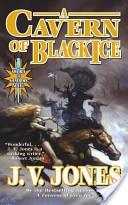
A Cavern of Black Ice by J.V. Jones

A Cavern of Black IceA Cavern of Black Ice by J.V. Jones was a hard read for me, but I made it all the way to the end. I should warn you that there is no resolution whatsoever; it’s one of those series books that simply stops, rather than providing a self-contained story. According to the Internets, there are four more books planned, but only two have been released.

It’s a low fantasy in the vein of Conan, meaning the world is dark and horrifying and Celtic and Norse and mountainous and snowy and the most advanced technology is the bow, fire, and horses. There is magic, but it’s demonic and unnatural.

What I liked was the tremendous attention to detail in the characterization and descriptions. The author brought attention to little things here and there that really pulled you into the world. The characters were complex, and grew and evolved over the course of the book, both good guys and bad guys. The writing was what I might call “heavy,” in that it had the feel of an aged, rough-voiced narrator telling a story of the ages. (As opposed to, say, something more frivolous.)

Unfortunately I thought the plot pacing suffered quite a bit for the detail. It was a little like Robert Jordan in that the author spent so much time on details that it took quite a while to move the story forward. I found myself skimming now and then when I wanted to get things moving.

The other problem was that it took a long time to get to a point where I felt like the story started. I felt like I was reading back story until roughly the point where Raif and Angus met up with Ash at the gate, which was well into the book. I want to say a third of the way through. Raif’s back story was not enough to keep me reading, but Ash was interesting enough that I wanted to see what happened to her. There were other plot elements and characters that were clearly setup for things in successive books and had little or no relevance to the first book.

For me as a writer, this book was a great example of low fantasy, and a great example of “going too far” on the details. A lot of people probably enjoy that, but I don’t think it’s in my writing wheelhouse. Certainly not for a rookie.

The Blade Itself, Part Two

I have heard for quite some time that Joe Abercrombie was more of a ”gritty” fantasy writer, more in the vein of George R.R. Martin than Robert Jordan. So that’s what I expected in The Blade Itself.

What I read was not gritty. I would describe it more as an action-adventure with a fantasy flavor. Actually it felt more like an urban fantasy style of writing in a medieval fantasy setting. The characters had a lot of flippancy in their dialog, and it was very fast-paced with no setting descriptions. But I’ll admit I only made it 15% through the book before I got bored.

I see that the book was nominated for a Campbell Award (for new writers) in 2008. Perhaps there was a dearth of fantasy books by new authors that year.

The Blade Itself

I’m taking a break after Book 8 of The Wheel of Time and reading some other things. I’ve started Joe Abercrombie’s The Blade Itself. Thusfar it’s not growing on me, but it’s still early. It is, at least, a very different style than Robert Jordan.

I know, I know, I haven’t written enough in the last few weeks. I’ll get back to it any day now! I will. Don’t look at me like that.